It is extremely important to translate materials in a way that makes them meaningful and culturally correct in the target languages. It may be necessary to localise and adapt some materials to make them relevant and easily understood in other countries.
Our document translation projects range from small, single language documents which require translation only, through to the most complex projects involving more than thirty languages and including many complex process steps. They often also involve multilingual typesetting, voice-overs and multimedia.

Document Translations
Translation can be a very subjective matter and we approach each project thoughtfully and with great care. We love to use any specialist terminology glossaries you may have to ensure that specific terms are translated consistently all the way through a document.
If you have no such glossaries in place, we can work with you to create them in advance or we will gradually build up a terminology list of terms specific to you as we carry out more projects.
Glossaries of terms with definitions are very useful as each company has their own jargon. A word with one meaning for one organisation might well have a different meaning within another organisation.
How to Ensure High Quality Translations
The choice of linguists is crucial in ensuring the success of your document translation projects. We search our extensive database of providers to find the most suitable people for your requirements. For each project, we look out for relevant and proven subject matter expertise in our translation teams. We also work closely with you in order to achieve the style that you prefer and to convey the correct message to your customers.
- All of our linguists are professionally qualified and have a minimum of three – five years’ experience.
- Our linguists only translate into their native languages.
- Our translation teams are generally resident in the country for which the translation is intended, especially if a detailed knowledge of that particular region is essential for an accurate document translation.
- The teams will have specific knowledge of the vocabulary of your business sector.
- The software and systems that we use are state of the art and can handle any level of production, from a simple business card through to the most complex multilingual translation project.
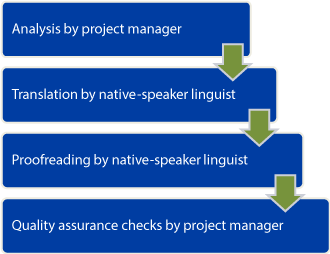
- For the vast majority of projects, our standard process involves translation and proofreading by two independent, native-speaker linguists, as per ISO translation standards. This is particularly important if the translation of a document is for external publication, rather than for internal use.
- Our skilled and experienced Project Managers always carry out a final check of any translated document before it is delivered to you.
Localisation and Adaptation
For some document translation projects, it won’t be simply enough to translate and proofread a file, as it may require further changes to make sure that it functions correctly in the target market. Read more about any potential further steps that may be required on our localisation and adaptation page.
Certified Translations
You may occasionally require a certified translation of your documents. This tends to be required for official processes such as a visa, immigration, bank account or other professional application in the United Kingdom or overseas.
In these cases, please contact us with details of the organisation or entity requesting the translation and we will be able to advise on how to proceed, as this depends on the country – some countries have dedicated lists of registered sworn translators, whereas in others, we are able to certify a translation as an ISO-certified translation agency that is a member of the Association of Translation Companies.
Budget Translation
Some of our customers occasionally need document translations for internal use or just to get the overall meaning. In such cases, it may require translation only. You can therefore dispense with the proofreading stage and this will reduce the cost to you.
We regularly translate surveys for our clients and most surveys contain one or two open-ended questions, where the respondents are invited to write down their responses. It is not necessary to have a completely polished translation in this case, so we don’t usually include proofreading in our pricing for this type of document translation project.


